
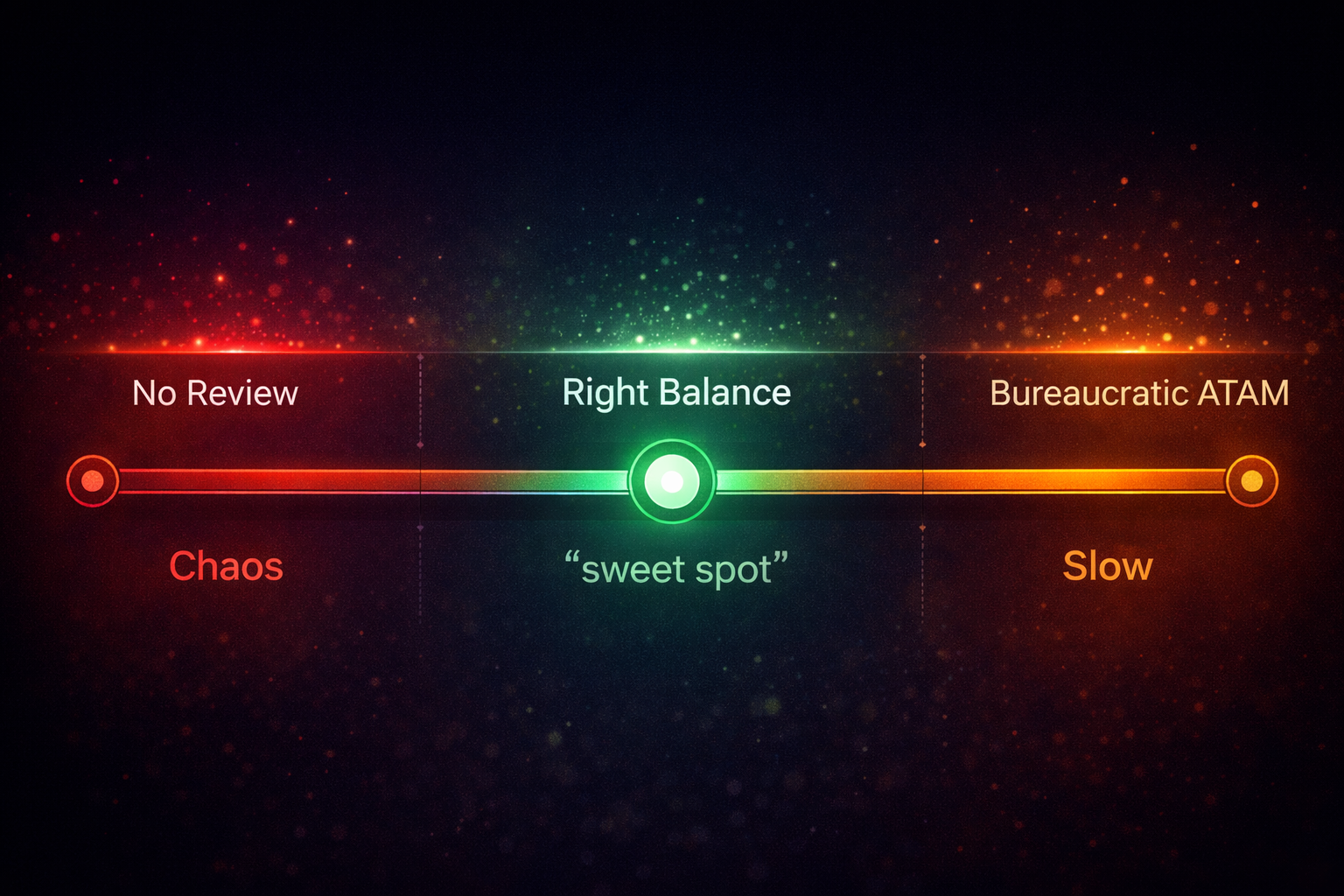
"Architecture review" often conjures images of formal committees, lengthy documents, and multi-week processes. For most teams, that's overkill.
But skipping reviews entirely? That's how you end up with systems no one can change and decisions no one remembers making.
There's a middle ground. Here's how to find it.
The Traditional Approach: ATAM
The Architecture Tradeoff Analysis Method (ATAM) is the gold standard for architecture evaluation. Developed at Carnegie Mellon's Software Engineering Institute, it has over 1,000 research citations.[1]
The Right Cadence
Not every review needs the same depth. Match your review type to your situation:
Running a Sprint-Level Review
Here's a practical template for a 45-minute architecture review during sprint planning:
45-Minute Sprint Review
- •Which tickets have architectural implications?
- •Any new integrations, services, or data stores?
- •Changes to existing APIs or contracts?
- •What could go wrong?
- •What are the dependencies?
- •What's the blast radius if this fails?
- •What decisions are being made?
- •Who is making them?
- •What's the context?
- •Need a deeper review?
- •Need stakeholder input?
- •Need to document anything?
Running a Quarterly Health Check
A quarterly review is deeper but still lightweight. Here's a structure for a half-day session:
Half-Day Quarterly Health Check
The Quality Attributes That Matter
Quality Attributes That Matter Most
Based on 15 years of ATAM evaluations across 31 projects[3]
Key insight: Modifiability tops the list. The ability to change your system is more important than almost any other quality—because requirements always change.
Spotify's Approach to Lightweight Governance
Spotify operates with autonomous squads, but they still need architectural alignment:
- Formalized process
- Cross-squad review
- Documented outcomes
- Standard code review
- Architecture context in PR
- Chapter review for patterns
- Regular specialist meetings
- Share common solutions
- Establish patterns organically
The key: different weight for different decisions
When to Use Full ATAM
Reserve heavy-weight reviews for high-stakes situations:
The ROI of Reviews
Architecture reviews reduce technical debt through early validation that catches problems before code is written, costing 10 times less than production fixes.
Making Reviews Stick
The hardest part isn't running reviews—it's making them habitual.
Architecture reviews aren't about process.
They're about preventing the problems you don't see coming.
References
- [1]Architecture Tradeoff Analysis Method (ATAM) - Software Engineering Institute, Carnegie Mellon University
- [2]Lightweight Architecture Evaluation - Software Engineering Institute, Carnegie Mellon University
- [3]A study on quality attributes commonly used in system design (15-year study across 31 ATAM evaluations) - Journal of Systems and Software