
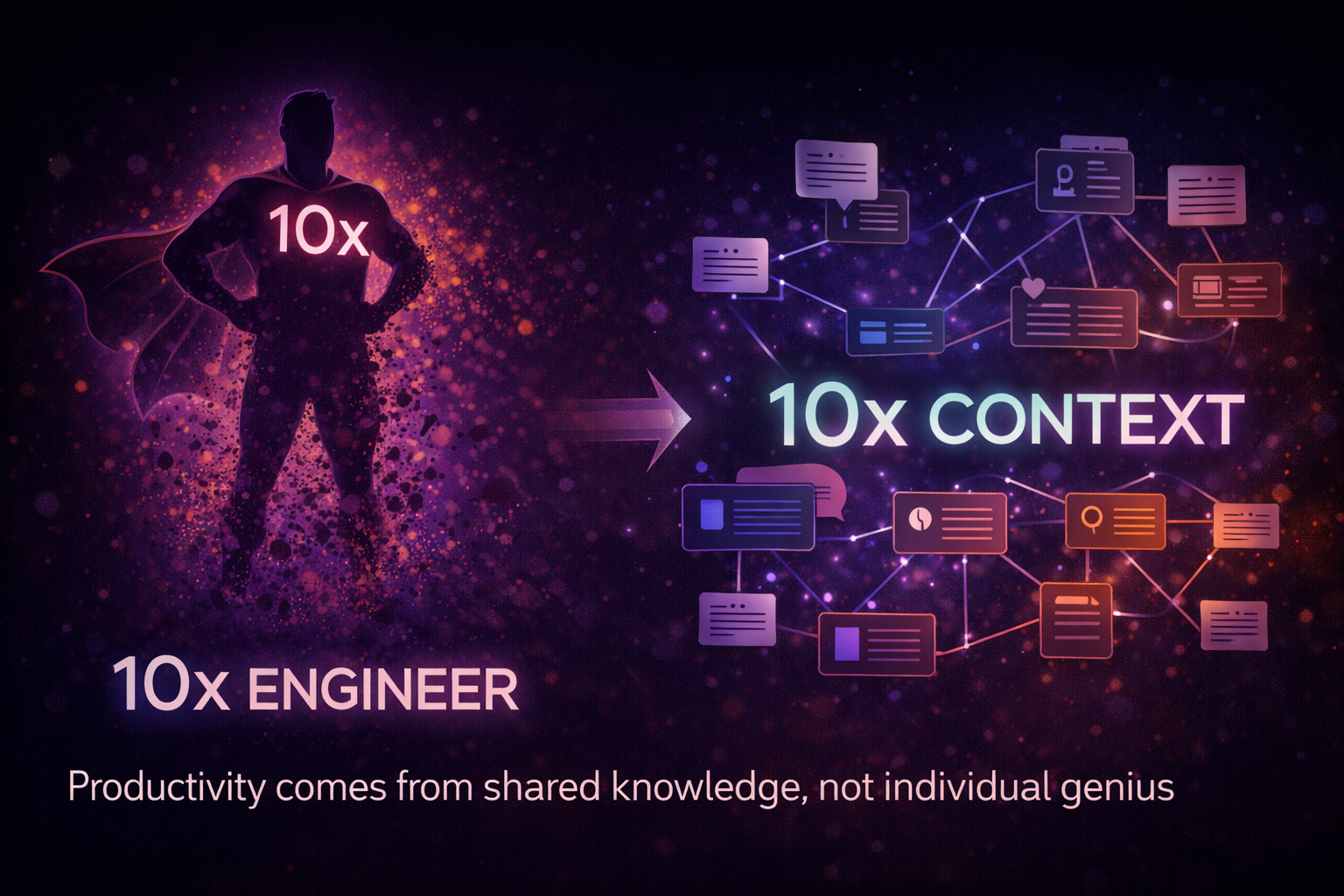
Silicon Valley loves the 10x engineer myth. The genius who produces ten times the output of their peers. The superhero who solves impossible problems while everyone else struggles.
Here's the uncomfortable truth: 10x engineers don't exist.
But 10x context does.
The productivity differences aren't about talent—they're about information asymmetry.
The Productivity Gap
Yes, there are massive productivity differences between engineers. Research by Sackman, Erikson, and Grant documented significant variations:
But here's what the research also shows: those differences aren't primarily about talent.
They're about information asymmetry.
The engineer who debugs 10x faster isn't 10x smarter. They know something others don't:
- Where the bodies are buried
- What was tried before
- Why the system works this way
- Which shortcuts are safe
The Context Advantage
Consider two engineers debugging the same problem:
- 1Reads the error message
- 2Searches Stack Overflow
- 3Tries various fixes
- 4Eventually discovers the issue
- 1Sees the error, recognizes the pattern
- 2Knows this happened before
- 3Knows the root cause and fix
Engineer B isn't 12x smarter.
They have 12x the relevant context.
Where Context Lives
In most organizations, critical context exists in three places—and all of them have problems:
People's Heads
Worst Place- High retrieval cost (find person, interrupt them, hope they remember)
- Zero redundancy (when they leave, context leaves)
Scattered Documentation
Better, But...- Often outdated
- Incomplete
- Unfindable
- Missing the why
The Code Itself
Tells You What, Not Why- Shows what the system does
- Nothing about why it does it
- Nothing about what was tried before
- Nothing about constraints driving decisions
The Institutional Memory Problem
Spent searching for information that should be accessible
When context lives in heads
- Senior engineers become bottlenecks
- New engineers stay slow longer
- Productivity gaps appear "natural"
When context is accessible
- Self-service replaces interrupts
- New engineers ramp faster
- The "10x engineer" advantage diminishes
Manufacturing 10x Engineers
Here's the provocative claim: you can manufacture 10x productivity.
Manufacturing 10x Productivity
Not by hiring better, but by democratizing context
Every engineer gets the context advantage that previously belonged only to long-tenured employees.
The Onboarding Test
Here's a diagnostic: how long until a new engineer can work independently?
But "productivity" often just means "can complete tasks without constant help"—a low bar.
Real productivity—making good decisions, not just executing tasks—often takes 6-12 months. Because that's how long it takes to absorb sufficient context through osmosis.
The 10x Trap
Celebrating 10x engineers creates perverse incentives
For the Organization
- Dependence on specific individuals
- Knowledge silos as power centers
- "Hero culture" instead of systems thinking
For Senior Engineers
- Job security through information hoarding
- Burnout from being the bottleneck
- Inability to take vacation
For Junior Engineers
- Learned helplessness
- Unclear path to productivity
- Invisible barriers to contribution
Building a Context-Rich Culture
Document Decisions, Not Just Outcomes
- What was decided
- Why it was decided
- What alternatives were rejected
- What constraints drove the choice
Make Context Searchable
- Centralized decision records
- Good tagging/categorization
- Search that actually works
Reward Context Sharing
- Write decision records
- Answer questions thoroughly & document answers
- Create onboarding materials
- Reduce your own 'irreplaceability'
Build Redundancy
- No system has single owner
- Rotate responsibilities
- Pair on critical work
- Make it impossible for context to exist in only one head
The Real 10x Engineer
The engineer who makes everyone else 2x more productive is worth more than the engineer who produces 10x on their own.
The Real 10x Engineer
Makes everyone else more productive
This engineer might not write the most code. But they create the conditions for everyone to succeed.
The Uncomfortable Truth
If your organization has "10x engineers," it probably has a documentation problem
Fix those problems, and the gap narrows. The "10x engineers" become "1.5x engineers with better documentation habits."
10x engineers don't exist. 10x context does.
Make context accessible, and everyone becomes more productive.