
Quick: what was the biggest architectural decision your team made last month?
If you're like most engineers, you might remember it happened. You might remember roughly what was decided. But the context? The alternatives? The tradeoffs?
Those are buried somewhere in Slack. Good luck finding them.
The Information Search Problem
The numbers are brutal[1]:
1.8hours/day
Searching for information
8hours/week
Lost to information search
2hours/week
Recreating existing info
For engineering teams, it's worse. Technical decisions are made in conversations—Slack threads, Zoom calls, hallway discussions. These conversations evaporate.
Where Decisions Actually Happen
Think about your last architectural decision. Where did it happen?
Where Decisions Actually Happen
The formal process isn't where decisions get made. It's where they get ratified.
The Slack Knowledge Problem
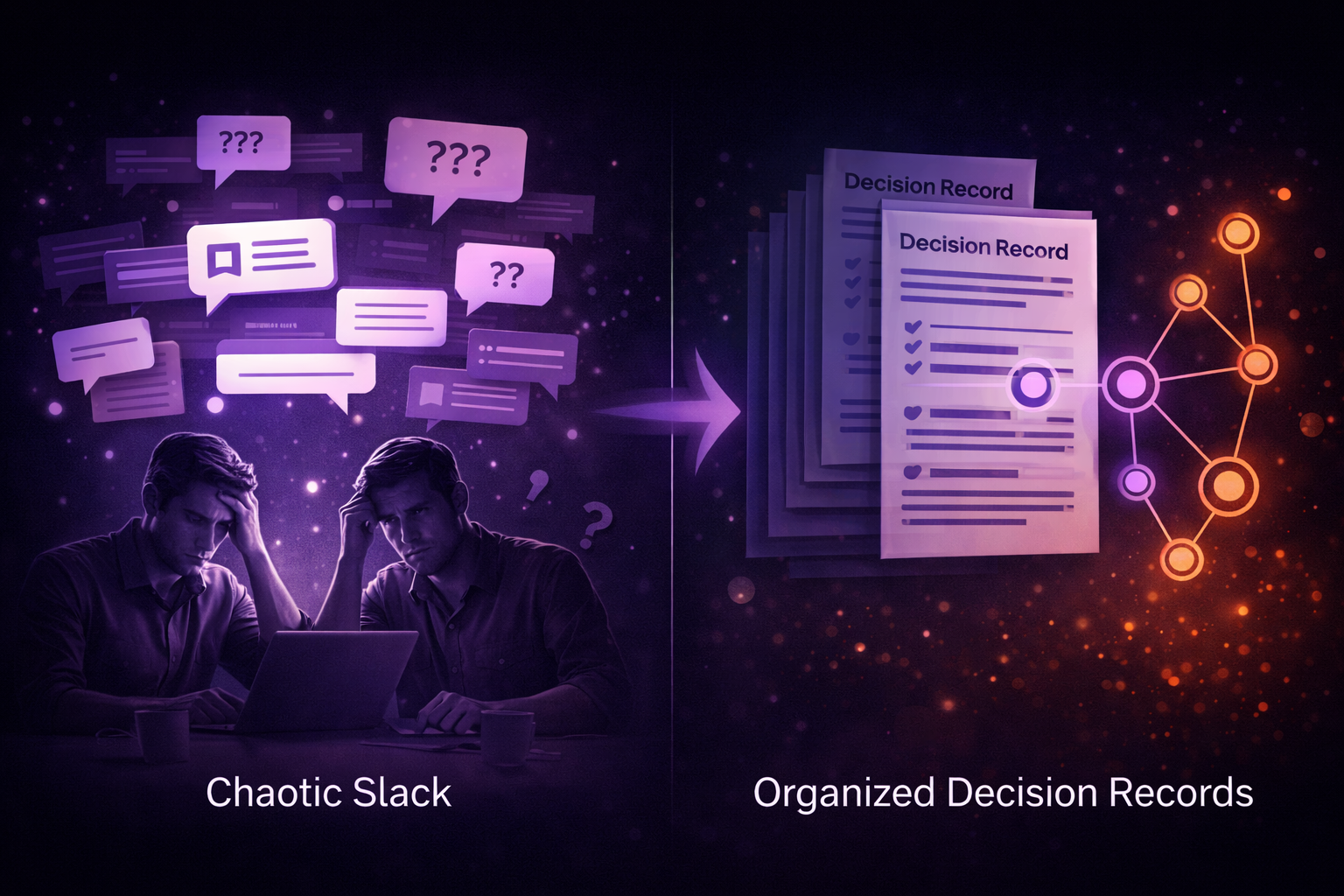
Slack is excellent for conversation. It's terrible for knowledge.
Conversations Are Linear
Important context scattered across 47 messages. You need to read the entire thread and reconstruct the logic.
Search Is Primitive
You need to know what you're looking for. Wrong words = invisible decision.
Context Decays
"Let's go with Redis" means nothing without knowing the problem or alternatives.
Channels Fragment
Database in #backend. API in #frontend. Capacity in #infra. The decision? Somewhere.
What Gets Lost
When a decision lives only in Slack, you lose:
Context
Why was this decision being made?
Alternatives
What other options were considered?
Tradeoffs
What downsides were accepted?
Stakeholders
Who had input? Who decided?
Timeline
When was this decided? Is it still valid?
Every missing piece is time someone will spend reconstructing it later.
This is decision archaeology fuel. Every missing piece is time someone will spend reconstructing it later.
Capturing Without Friction
The solution isn't “have more meetings” or “write more documents.” It's capturing decisions in the flow of work.
Slack-Native Capture
Capture decisions where they happen with structured templates
Automated Extraction
Tools watch for decision patterns and prompt for capture
Weekly Decision Sweeps
"What decisions did we make this week?" Takes 15 minutes.
Slack-Native Capture
📌 Decision captured
Decision: Using Redis for session storage
Context: Need sub-millisecond reads, 10k+ requests/sec
Alternatives: PostgreSQL (too slow), Memcached (no persistence)
Tradeoffs: Accepts data loss on Redis failure
Owner: @sarah | Date: Oct 15
Even this minimal structure preserves what matters.
The ROI of Structured Records
Research shows structured knowledge management yields concrete returns[2][3][4]:
60%
of support tickets could be resolved through documentation
73%
reduction in expert workloads with integrated knowledge tools
$100-250
cost per deflected ticket (higher for SME involvement)
For engineering teams, “tickets” = “questions about why things work.” Every documented decision deflects future confusion.
Building the Habit
Start With High-Stakes
- API/contract changes
- New technologies
- Security choices
- Scaling decisions
Make It Easy
- Slash commands
- Templates
- AI extraction
- Reduce friction
Review Regularly
- Architecture reviews
- Sprint planning
- Onboarding
- Reference often
Measure Coverage
- Track capture rate
- Can new hires find?
- Team health metric
- Audit periodically
The Modern Workflow
The best teams don't treat documentation as separate from work. They treat it as part of work:
The Modern Decision Workflow
Discussion happens
Slack, meeting, PR
Decision emerges
Someone commits
Capture is prompted
Tool or habit
Record is created
With context
Record is linked
Code, systems, decisions
Record is reviewed
Quarterly or as needed
What Changes
When decisions move from Slack threads to structured records:
New Engineers
Can onboard by reading decision history
Future You
Can remember why you made that choice
Leadership
Can understand decisions being made
Auditors
Can verify compliance
Teams
Can learn from past decisions
The institutional memory becomes an asset instead of a liability.
Your best thinking happens in conversations. Make sure it survives them.